Tim Trautmann / Archive
Cart

1390 photographs, licensable by the hour or the century.

By category
A · 222 / B · 600 / C · 574
/
Clear ×
Filter

Showing results for "Port Infrastructure"
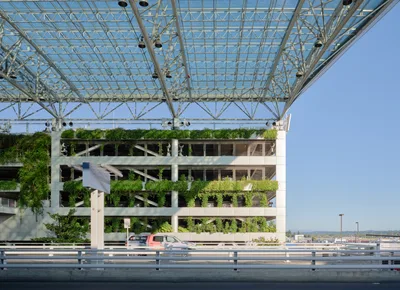
A striking view of Portland International Airport's innovative short-term parking garage showcases the marriage of sustainable design and modern infrastructure. Cascading vegetation transforms the concrete structure into a verdant vertical garden, while an intricate steel and glass canopy overhead creates geometric patterns against the clear Oregon sky. The foreground highway barrier frames this architectural achievement, where a lone red vehicle provides scale to the ambitious green building initiative that defines PDX's commitment to environmental stewardship.
Lush vegetation cascades down the facades of Portland International Airport's eco-friendly parking structure, crowned by an expansive geometric canopy.
Living Architecture at Portland International Airport
B
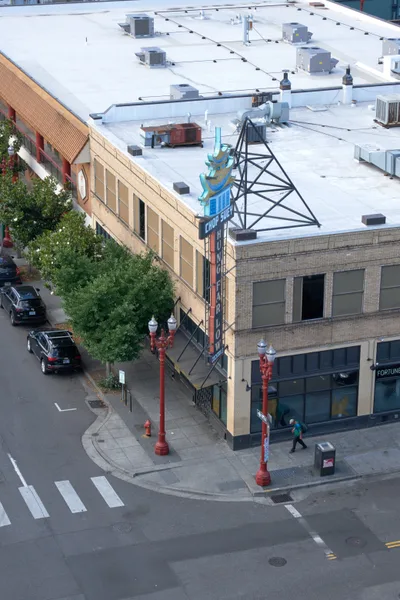
An elevated perspective captures the intersection where traditional meets contemporary in Portland's Chinatown district. The geometric precision of white crosswalk stripes guides the eye through a scene where vintage brick architecture houses modern commerce, while HVAC units dot the pristine white rooftop like mechanical sentinels. Red street lamps stand as colorful punctuation marks against the muted palette of concrete and brick, their warm hue echoing the neighborhood's cultural heritage.
Street-level commerce and rooftop infrastructure converge at a Chinatown intersection in Portland, Oregon, where traditional architectural elements meet modern urban functionality.
Urban Corner Chronicle in Portland Chinatown
B
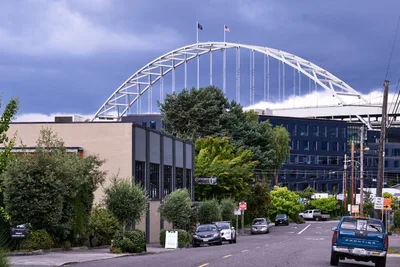
The iconic white steel arch of Portland's Fremont Bridge soars majestically against a dramatic sky of periwinkle and storm clouds, its suspension cables creating rhythmic vertical lines. Viewed from the tree-lined streets of the Slab Town neighborhood, the modernist bridge dominates the urban landscape while leafy deciduous trees and contemporary buildings frame the foreground. Two flags flutter atop the bridge's peak, while parked cars and residential streets below emphasize the human scale against this monumental infrastructure.
The Fremont Bridge's distinctive white arch spans above Northwest Portland's Slab Town neighborhood, framed by summer foliage and stormy skies.
Fremont Bridge Rises Above Northwest Portland
B
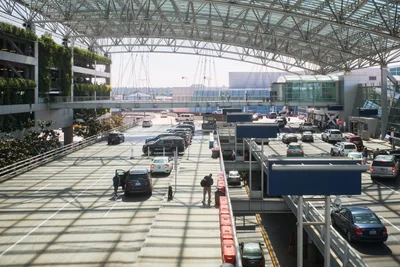
The multi-level departures roadway at Portland International Airport bustles with vehicular activity beneath a soaring canopy of steel trusses and glass. Cars queue in organized lanes while passengers load luggage and navigate the concrete plaza, creating a choreographed dance of arrival and departure. Dappled shadows from the architectural framework create geometric patterns across the pavement, while the terminal's modern glass facade gleams in the background. The scene captures the perpetual motion of modern air travel infrastructure, where engineering precision meets human transit needs.
Vehicles navigate the multi-tiered departures area at Portland International Airport under the terminal's distinctive steel and glass canopy.
Portland Airport Departures Traffic Flow
C
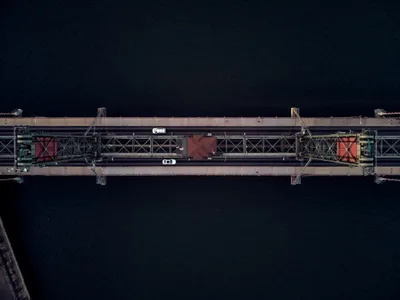
A precise aerial perspective captures Portland's historic Hawthorne Bridge spanning the dark Willamette River at dusk. The steel truss structure stretches across the frame in perfect symmetry, its weathered concrete deck illuminated by scattered streetlights while two vehicles traverse the span. The inky waters below create a stark void that emphasizes the bridge's engineered geometry and vital connection between Portland's eastside neighborhoods and downtown core.
An aerial view reveals the Hawthorne Bridge's steel truss architecture spanning the Willamette River in Portland, Oregon.
Hawthorne Bridge Suspended Over Willamette Waters
A
Portland Fire & Rescue Station 21 sits anchored on the Willamette River beneath the gentle light of an overcast evening sky. The modern floating firehouse, distinguished by its corrugated metal roof and red support pilings, connects to shore via a steel gangway, creating a unique waterfront emergency response facility. Towering Lombardy poplars frame the scene while the Hawthorne Bridge spans the background, establishing the station's strategic location in Portland's Central Eastside industrial district.
Portland Fire & Rescue Station 21 serves as a floating emergency response facility on the Willamette River in Oregon's largest city.
Floating Fire Station on Portland's Willamette River
C
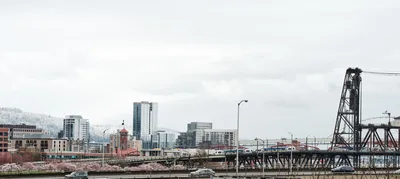
Delicate cherry blossoms in soft pink create a foreground curtain against Portland's modern cityscape, viewed from the Burnside Bridge area. The overcast Oregon sky bathes the scene in diffused light, while the iconic steel drawbridge structure anchors the right side of the composition. Mid-rise buildings and hotels punctuate the urban core, their glass and concrete forms contrasting with the ephemeral beauty of spring's arrival. The juxtaposition captures Portland's character—where natural cycles persist alongside urban development.
Cherry blossoms frame Portland's downtown skyline and the Burnside Bridge during spring bloom season.
Spring Blossoms Frame Portland's Industrial Skyline
B
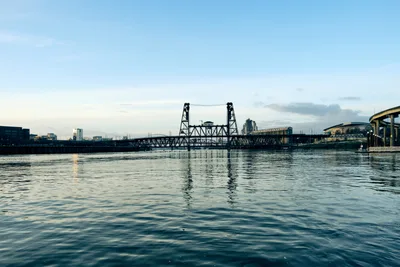
The iconic Steel Bridge spans the Willamette River in downtown Portland, its distinctive lift towers and truss structure creating dramatic silhouettes against a pale afternoon sky. The calm water mirrors the bridge's industrial framework and surrounding cityscape, while soft light catches the rippling surface. Modern buildings and infrastructure frame the scene, capturing the essence of Portland's riverfront where industrial heritage meets contemporary urban development.
Portland's Steel Bridge creates mirror-perfect reflections on the tranquil Willamette River during the afternoon.
Steel Bridge Reflections on Willamette River
C
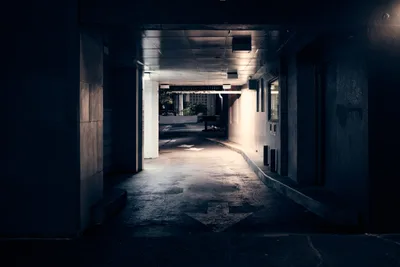
A moody corridor stretches through the basement level of Portland's historic Weatherly Building, where dramatic chiaroscuro lighting cuts through concrete and steel infrastructure. Harsh fluorescent strips illuminate the industrial ceiling while deep shadows pool along weathered walls, creating an atmospheric tunnel that speaks to the building's utilitarian past. The perspective draws the eye toward a distant opening where natural light hints at the world above, framed by exposed pipes and institutional fixtures that define this subterranean passage.
Dramatic lighting reveals the industrial basement corridor of Portland's historic Weatherly Building in the Central Eastside district.
Underground Passage Portland Historic Building
C
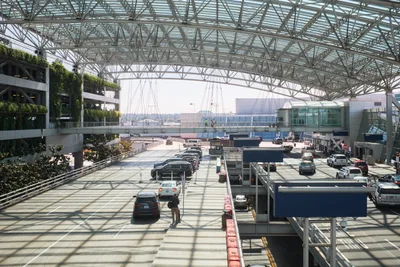
Beneath Portland International Airport's soaring latticed canopy, the departures driveway bustles with purposeful activity as travelers navigate the covered drop-off zone. The geometric steel framework creates dramatic shadows across the concrete surface while cars queue in organized lanes, their occupants preparing for journeys ahead. Green living walls on the terminal's left side soften the industrial architecture, while the distant mountains provide a serene backdrop to this choreographed transportation hub.
Travelers and vehicles move through the covered departures driveway at Portland International Airport beneath the terminal's distinctive steel canopy structure.
Departures Driveway Portland International Airport
C
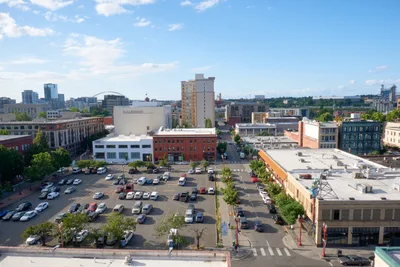
An elevated view captures the bustling intersection of Portland's historic Chinatown district, where a sun-drenched parking lot anchors the urban composition. Mid-rise buildings in varied architectural styles create a textured skyline against wispy white clouds, while the Kalberer building stands prominently among mixed-use structures. The afternoon light bathes the scene in warm tones, revealing the neighborhood's blend of residential towers, commercial buildings, and tree-lined streets that define this evolving urban landscape.
An aerial perspective showcases the dynamic urban fabric of Portland's Chinatown district, where parking infrastructure meets diverse architectural styles under a bright Pacific Northwest sky.
Portland Chinatown Urban Vista from Above
B
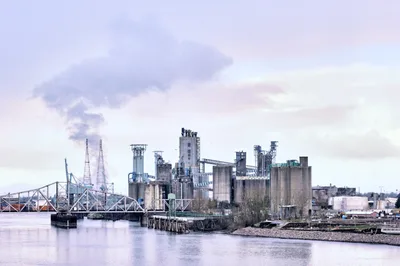
The United Grain Corporation's Vancouver Export Terminal rises from the Columbia River's edge in a symphony of concrete silos, steel conveyor bridges, and industrial towers. Captured during the warm afternoon hours, the facility's imposing structures are bathed in soft lavender and rose-tinted light, their reflections shimmering across the glassy water. A steel truss bridge spans the river in the left frame, connecting this vital grain export hub to the broader Pacific Northwest transportation network.
The United Grain Corporation's Vancouver Export Terminal and Great Western Malting's grain processing facility reflect in the Columbia River's still waters during afternoon hours at Jantzen Beach.
Afternoon Light at Columbia River Grain Terminal
C
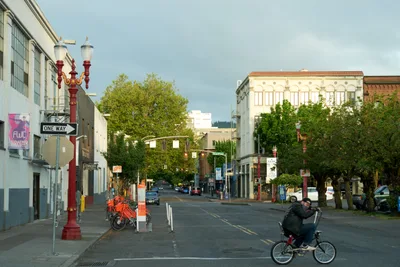
A lone cyclist navigates the quiet streets of Portland's Chinatown-Japantown Historic District as morning light settles over Northwest Everett Street. The scene captures the neighborhood's blend of heritage architecture and modern urban life, with ornate red street lamps standing against the pale morning sky. Historic storefronts line the street while a bike-share station stands ready on the left sidewalk, embodying the district's transition between its cultural past and contemporary Pacific Northwest lifestyle.
A cyclist travels through Portland's historic Chinatown district during the early morning hours, where traditional red lampposts frame the intersection of heritage and modern urban mobility.
Morning Cyclist in Portland's Historic Chinatown
C
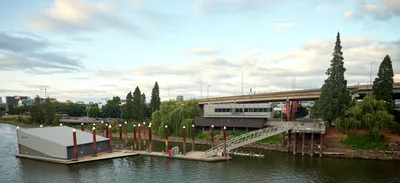
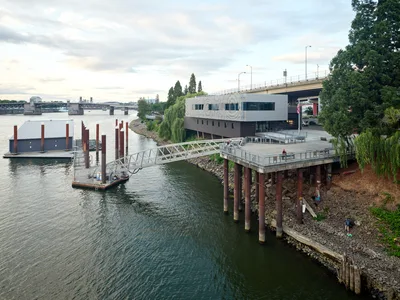
Portland Fire & Rescue Station 21 sits anchored in the Willamette River beneath the Southeast Madison Street Bridge, its modern floating structure serving the Central Eastside industrial district. The utilitarian gray building extends over dark waters on wooden pilings, connected to shore by a pedestrian gangway that spans the vegetated riverbank. Towering conifers and weeping willows frame the scene under a brooding Pacific Northwest sky, while the concrete bridge arches overhead, linking the city's urban fabric.
Portland Fire & Rescue Station 21 operates from its unique floating facility on the Willamette River at the foot of Southeast Madison Street.
Portland Fire Station 21 Floating Facility
C
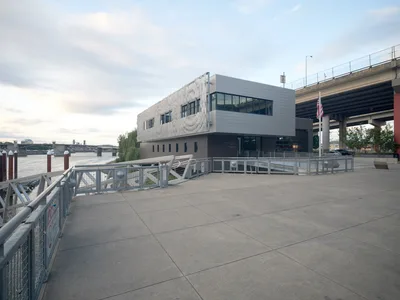
Portland Fire & Rescue Station 21 stands as a striking example of contemporary civic architecture along the Willamette River waterfront. The three-story building features a distinctive white sculptural facade contrasting with corrugated metal siding, positioned beneath the Southeast Madison Street bridge structure. Concrete walkways with metal railings frame the foreground under an overcast evening sky, while the distant river and bridge create layers of urban infrastructure.
Portland Fire & Rescue Station 21 showcases modern emergency services architecture along the Willamette River beneath the Southeast Madison Street bridge.
Portland Fire Station 21 Riverfront Architecture
C
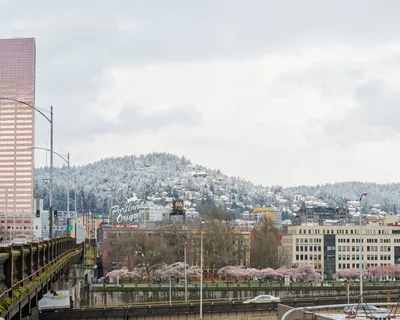
A contemplative winter scene captures Portland's Old Town and eastside waterfront from the iconic Burnside Bridge perspective during a March 2020 snowfall. The composition juxtaposes urban infrastructure—concrete bridge barriers and the distinctive 'Portland Oregon' neon sign—against snow-dusted West Hills dotted with residential homes. Cherry blossoms in Tom McCall Waterfront Park provide delicate pink punctuation along the Willamette River's edge, while overcast skies create a muted, ethereal atmosphere that softens the industrial cityscape.
Snow blankets Portland's West Hills as viewed from Burnside Bridge during an unusual March 2020 winter storm, with cherry blossoms blooming along the waterfront below.
Portland Winter Cityscape from Burnside Bridge
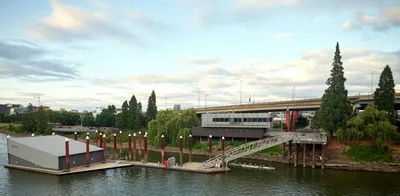
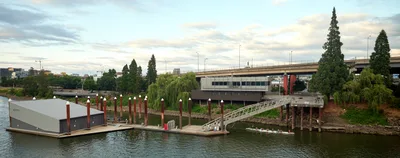
Portland Fire & Rescue Station 21 sits serenely on the Willamette River beneath soft afternoon clouds, its modern floating dock structure anchored by rust-red pilings that pierce the calm waters. The sleek gray boathouse contrasts against the verdant landscape of Central Eastside, where towering evergreens frame the Madison Bridge's concrete span. Willow trees cascade toward the riverbank while urban infrastructure creates geometric layers in the background, capturing the harmonious intersection of emergency services and Portland's natural waterways.
Portland Fire & Rescue Station 21's floating dock facility on the Willamette River provides water rescue capabilities beneath the Madison Bridge in Portland's Central Eastside district.
Portland Fire Station 21 Floating Dock
C
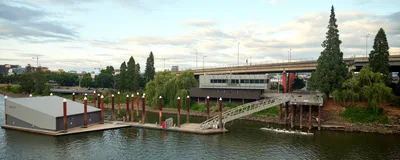
Portland Fire & Rescue Station 21 sits serenely on the Willamette River at the foot of Southeast Madison Street, its modern floating structure anchored by distinctive red pilings that march in formation toward the shore. The corrugated metal boathouse reflects the overcast Pacific Northwest sky while a white pedestrian bridge connects the water-based facility to the Central Eastside embankment. Towering evergreens and urban infrastructure frame this unique emergency response outpost, where tradition meets innovation in river rescue operations.
Portland Fire & Rescue Station 21 operates from its distinctive floating facility on the Willamette River, connected to the Central Eastside by a pedestrian bridge and secured with characteristic red moorings.
Portland Fire Station 21 Willamette River Dock
C
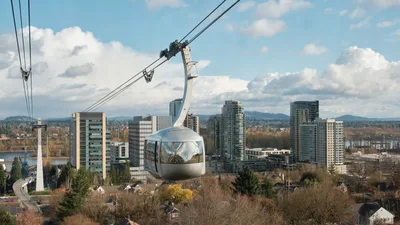
A sleek silver gondola car of the Portland Aerial Tram floats gracefully through autumn air, its reflective surface catching the soft overcast light above the South Waterfront district. The panoramic view reveals Portland's modern high-rise towers nestled between the Willamette River and rolling hills, while bare-branched trees in the foreground signal late fall's arrival. The composition captures both the engineering marvel of the tram system and the urban landscape it serves, connecting OHSU's Marquam Hill campus to the bustling waterfront below.
The Portland Aerial Tram approaches its upper terminal at Oregon Health & Science University, offering passengers sweeping views of the city's South Waterfront district and the Willamette River beyond.
Portland Aerial Tram Glides Over South Waterfront
A
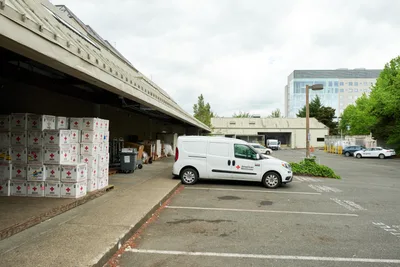
Under overcast Pacific Northwest skies, a white American Red Cross delivery van sits positioned at a concrete loading dock in the organization's Cascades Region facility on North Vancouver Avenue. Towering stacks of empty blood platelet boxes marked with red crosses await collection inside the shadowed warehouse bay, while the modern glass facade of a Portland office building rises in the background. The utilitarian scene captures the operational backbone of humanitarian aid distribution in Oregon's largest city.
Empty blood platelet boxes await collection at the American Red Cross Cascades Region facility in Portland, Oregon, as a delivery van prepares for the next distribution cycle.
Red Cross Distribution Center Portland Oregon
C
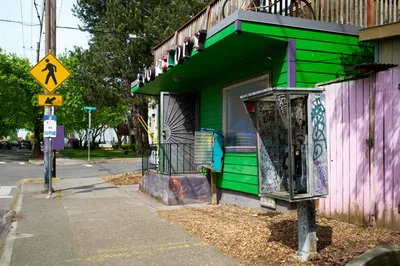
A weathered pay phone stands sentinel on a North Williams Avenue corner in Portland's Eliot neighborhood, its metal frame adorned with layers of colorful street art and stickers. The phone sits beside a vibrant green wooden building with purple trim, while pedestrian crossing signs and urban infrastructure frame the scene under diffused daylight. Wood chips scattered at the base and power lines overhead complete this quintessential portrait of Portland's eclectic streetscape.
A sticker-covered pay phone anchors a street corner in Portland's historically significant Albina district.
Graffitied Pay Phone on Portland Street Corner
C
Portland Fire & Rescue Station 21 emerges from the Willamette River shoreline like a modernist beacon, its angular concrete form cantilevering over the water on weathered steel pilings. The facility's distinctive floating dock system extends into the jade-green current, while the Southeast Madison Street bridge spans the horizon under a brooding Pacific Northwest sky. This architectural marvel represents the intersection of urban emergency services and riverfront infrastructure, captured during the soft light of an overcast afternoon.
Portland Fire & Rescue Station 21 extends over the Willamette River with its distinctive floating dock system and modern concrete architecture.
Waterfront Fire Station Spans Willamette River
C
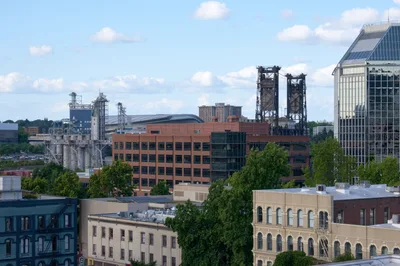
An elevated view across Portland's historic Chinatown district reveals a compelling juxtaposition of architectural eras under a partly cloudy afternoon sky. The foreground showcases traditional brick and masonry buildings with arched windows, while mid-ground industrial structures including towering grain silos and processing facilities create dramatic vertical elements. Modern glass-clad high-rises pierce the horizon, their reflective surfaces catching the natural daylight that bathes this diverse urban landscape in warm, even tones.
Mixed-era architecture defines Portland's Chinatown district, where historic brick buildings coexist with industrial infrastructure and modern skyscrapers.
Portland Chinatown Industrial Skyline Vista
B
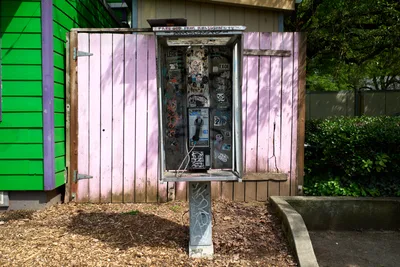
A weathered payphone stands as a working relic of communication past, its pink wooden shutters opened to reveal a graffiti-covered interior densely packed with stickers and street art. Surrounded by urban debris with wood chips scattered at its base, the functional phone creates a stark contrast against the vibrant green siding of a nearby building. Dappled sunlight filters through overhead foliage, casting gentle shadows across this active piece of telecommunications infrastructure in Portland's Eliot neighborhood.
A functional payphone covered in street art sits among urban debris in Portland's Eliot district.
Functional Payphone in Portland Neighborhood
C
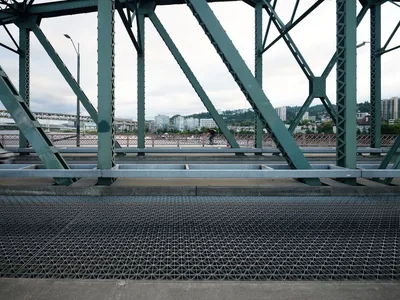
Industrial geometry frames the Portland skyline through the steel lattice work of the historic Hawthorne Bridge. Weathered green trusses create a rhythmic pattern of triangular supports, their riveted joints speaking to early 20th century engineering. Beyond the bridge's skeletal framework, modern residential towers rise against forested hills under an overcast Pacific Northwest sky, while the textured metal grating beneath adds tactile depth to this architectural intersection of past and present.
The iconic steel trusses of Portland's Hawthorne Bridge frame the city's evolving skyline across the Willamette River.
Steel Lattice Through Hawthorne Bridge Span
B
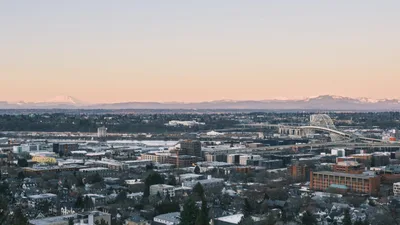
The sprawling neighborhoods of Northwest Portland unfold beneath a pastel dusk sky, where residential homes nestle between modern apartment complexes and commercial buildings. The iconic white arches of the Fremont Bridge span the distant Willamette River, while the snow-capped silhouette of Mount Saint Helens anchors the horizon in Washington State. Golden hour light bathes the urban landscape in warm tones, creating a serene contrast between the intimate scale of residential streets and the grandeur of the Cascade Range beyond.
Northwest Portland's diverse urban fabric stretches toward Mount Saint Helens and the Fremont Bridge during the golden hour.
Portland's Urban Tapestry Beneath Cascade Peaks
B
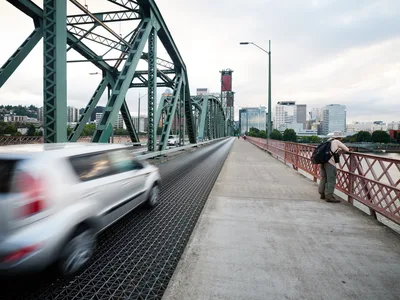
A solitary figure in a sun hat leans against the distinctive red pedestrian railing of Portland's iconic Hawthorne Bridge, gazing toward the city skyline as traffic streams past in a blur of motion. The weathered green steel truss structure frames the scene under overcast Pacific Northwest skies, while downtown Portland's modern towers rise beyond the Willamette River. The composition captures the contrast between human stillness and urban velocity, with the bridge's industrial architecture serving as a timeless connector between the city's east and west sides.
A pedestrian contemplates the Portland skyline from the Hawthorne Bridge as traffic flows across the historic steel truss span over the Willamette River.
Urban Commuter Pauses on Portland's Hawthorne Bridge
B
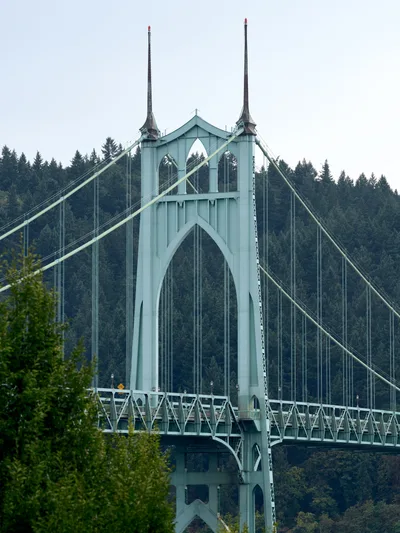
The iconic St. Johns Bridge rises majestically from the dense evergreen canopy of Portland's Forest Park, its distinctive Gothic Revival towers crowned with crimson-tipped spires piercing an overcast Pacific Northwest sky. The pale green suspension bridge creates a striking architectural contrast against the deep emerald forest below, while soft diffused light emphasizes the bridge's cathedral-like arches and Art Deco details. Lush vegetation frames the foreground, drawing the eye upward to where steel cables sweep gracefully between the towering concrete pylons.
The Gothic Revival towers of Portland's St. Johns Bridge emerge from the forested Willamette River corridor, creating one of the Pacific Northwest's most distinctive architectural landmarks.
Gothic Revival Towers Pierce Pacific Northwest Sky
A
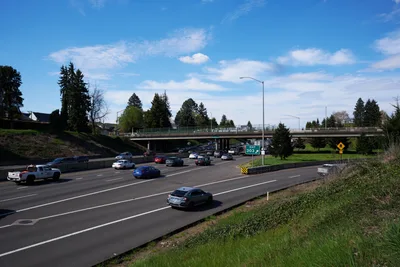
Activists from the Indivisible movement stage a banner drop from a pedestrian overpass spanning Interstate 5 in North Portland, their protest banner visible against the spring sky as afternoon traffic flows beneath. The concrete bridge arcs over multiple lanes of busy freeway traffic, with evergreen trees and residential neighborhoods framing the scene under wispy clouds. This moment captures civic engagement intersecting with daily commuter life, as the activists' May 1st General Strike message reaches drivers below on one of the Pacific Northwest's major transportation arteries.
Indivisible movement activists conduct a banner drop over Interstate 5 in North Portland, promoting awareness for a May 1st General Strike to passing motorists.
Activists Banner Drop Over Interstate Five Portland
C
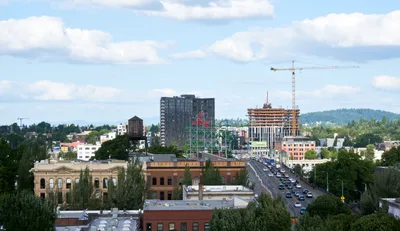
An elevated cityscape view captures Portland's Chinatown district where historic brick buildings meet contemporary high-rise construction. Tower cranes punctuate the skyline as new development rises alongside the ornate classical facade of a heritage building in the foreground. The Burnside Bridge carries steady traffic through the urban corridor, while forested hills provide a verdant backdrop to this evolving neighborhood where preservation and progress intersect.
Construction cranes tower over Portland's Chinatown as new high-rise development transforms the historic district beneath partly cloudy Pacific Northwest skies.
Portland Chinatown Development and Historic Architecture
B

Search tags, trending this week