Tim Trautmann / Archive
Cart

1495 photographs, licensable by the hour or the century.

By category
A · 226 / B · 649 / C · 627
/
Clear ×
Filter

Showing results for "Portland Architecture"
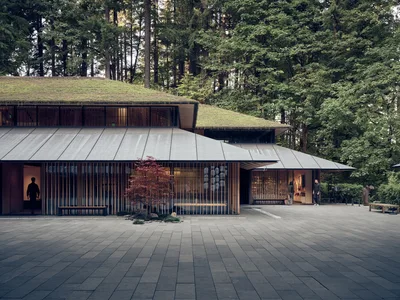
A striking contemporary pavilion emerges from the Portland Japanese Garden, its grass-covered living roof seamlessly blending into the surrounding Pacific Northwest forest. The building's modernist design features vertical wooden slats, metal roofing, and floor-to-ceiling windows that reveal warm interior lighting at dusk. A solitary figure silhouetted in the left entrance adds human scale to the architectural composition, while a crimson Japanese maple provides a delicate counterpoint to the structure's bold horizontal lines.
The contemporary Cultural Village pavilion at Portland Japanese Garden showcases sustainable architecture with its living roof merging into the surrounding woodland canopy.
Living Roof Architecture Portland Japanese Garden
B
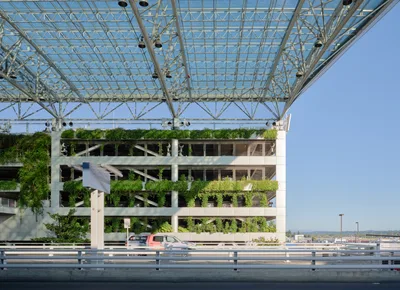
A striking view of Portland International Airport's innovative short-term parking garage showcases the marriage of sustainable design and modern infrastructure. Cascading vegetation transforms the concrete structure into a verdant vertical garden, while an intricate steel and glass canopy overhead creates geometric patterns against the clear Oregon sky. The foreground highway barrier frames this architectural achievement, where a lone red vehicle provides scale to the ambitious green building initiative that defines PDX's commitment to environmental stewardship.
Lush vegetation cascades down the facades of Portland International Airport's eco-friendly parking structure, crowned by an expansive geometric canopy.
Living Architecture at Portland International Airport
B
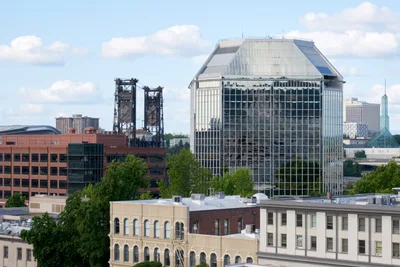
A striking glass conservatory with Victorian-inspired architecture dominates the Portland skyline, its crystalline greenhouse structure gleaming against scattered white clouds. The image captures the juxtaposition of this horticultural landmark against the industrial backdrop of the Fremont Bridge's steel towers and the modern downtown core. Historic brick buildings anchor the foreground, their weathered facades telling stories of Old Town's commercial past, while lush summer foliage softens the urban edges.
The glass conservatory stands as an architectural jewel in Portland's Old Town Chinatown district, framed by the Fremont Bridge and downtown skyline.
Portland Chinatown Glass Conservatory Architecture
B
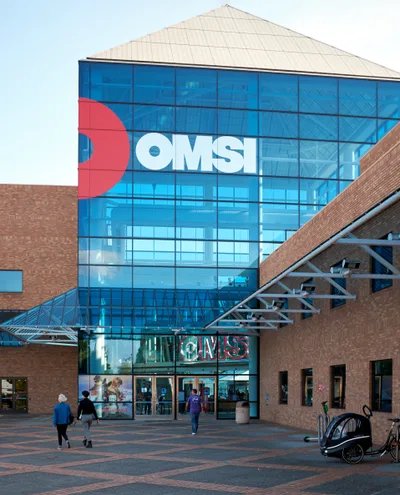
The Oregon Museum of Science and Industry's striking contemporary facade dominates this evening view, where warm brick construction contrasts dramatically with expansive blue-tinted glass panels bearing the iconic OMSI logo. Visitors move leisurely across the geometric brick plaza as twilight approaches, while modern steel canopies frame the museum's main entrance. The architectural interplay of transparent and solid surfaces creates a dynamic composition that captures the institution's blend of accessibility and innovation along Portland's industrial waterfront.
Visitors gather at the Oregon Museum of Science and Industry as evening light illuminates the museum's distinctive glass and brick architecture along Portland's Willamette River waterfront.
OMSI's Contemporary Glass Architecture on Portland Waterfront
B
Portland Fire & Rescue Station 21 emerges from the Willamette River shoreline like a modernist beacon, its angular concrete form cantilevering over the water on weathered steel pilings. The facility's distinctive floating dock system extends into the jade-green current, while the Southeast Madison Street bridge spans the horizon under a brooding Pacific Northwest sky. This architectural marvel represents the intersection of urban emergency services and riverfront infrastructure, captured during the soft light of an overcast afternoon.
Portland Fire & Rescue Station 21 extends over the Willamette River with its distinctive floating dock system and modern concrete architecture.
Waterfront Fire Station Spans Willamette River
C
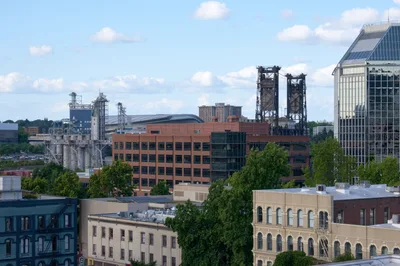
An elevated view across Portland's historic Chinatown district reveals a compelling juxtaposition of architectural eras under a partly cloudy afternoon sky. The foreground showcases traditional brick and masonry buildings with arched windows, while mid-ground industrial structures including towering grain silos and processing facilities create dramatic vertical elements. Modern glass-clad high-rises pierce the horizon, their reflective surfaces catching the natural daylight that bathes this diverse urban landscape in warm, even tones.
Mixed-era architecture defines Portland's Chinatown district, where historic brick buildings coexist with industrial infrastructure and modern skyscrapers.
Portland Chinatown Industrial Skyline Vista
B
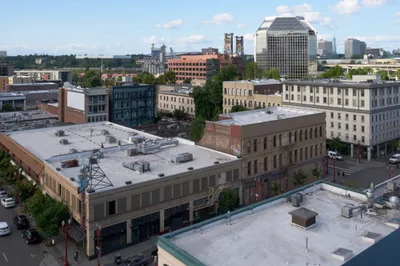
An elevated perspective captures the historic architecture of Portland's Chinatown district on a partly cloudy afternoon. The foreground showcases weathered brick buildings with flat rooftops dotted with HVAC equipment, while mid-century structures with distinctive facades stretch toward the horizon. In the distance, gleaming downtown high-rises pierce a soft blue sky scattered with white cumulus clouds, creating a compelling juxtaposition between the neighborhood's intimate scale and the city's vertical ambitions.
Historic brick buildings in Portland's Chinatown create layers of urban texture beneath gathering afternoon clouds.
Portland Chinatown Urban Landscape Aerial View
B
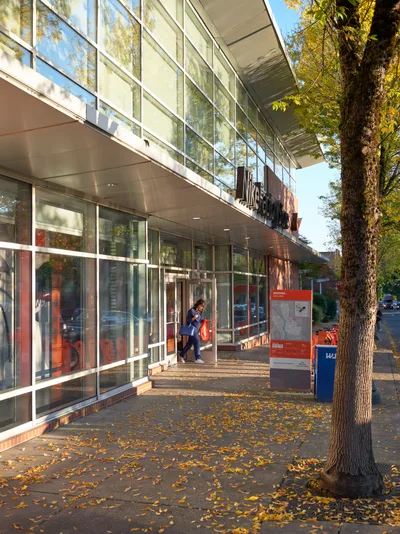
A lone shopper with a red bag walks through the modern glass-walled Nike Factory Store in Portland during golden hour autumn morning. Fallen yellow leaves carpet the concrete walkway beneath mature trees, while warm sunlight filters through the contemporary architecture's expansive windows. The scene captures the quiet rhythm of retail life as the store opens, with orange and blue Nike signage marking this retail destination.
A shopper navigates Nike's modern retail architecture amid autumn's golden carpet in Portland.
Autumn Morning at Nike Factory Store Portland
C
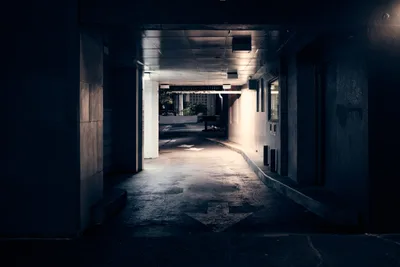
A moody corridor stretches through the basement level of Portland's historic Weatherly Building, where dramatic chiaroscuro lighting cuts through concrete and steel infrastructure. Harsh fluorescent strips illuminate the industrial ceiling while deep shadows pool along weathered walls, creating an atmospheric tunnel that speaks to the building's utilitarian past. The perspective draws the eye toward a distant opening where natural light hints at the world above, framed by exposed pipes and institutional fixtures that define this subterranean passage.
Dramatic lighting reveals the industrial basement corridor of Portland's historic Weatherly Building in the Central Eastside district.
Underground Passage Portland Historic Building
C
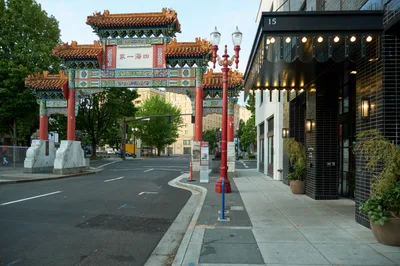
A vibrant Chinese ceremonial archway stands as the entrance to Portland's historic Chinatown district, its ornate red pillars and golden-tiled rooflines creating a striking contrast against the contemporary urban landscape. The early morning light bathes the empty street in a warm glow, while modern buildings including The Hoxton Hotel frame the traditional architecture. String lights from a nearby establishment add a gentle sparkle to the quiet intersection, capturing the seamless blend of cultural heritage and modern city life.
The ornate gateway to Portland's Chinatown creates a stunning juxtaposition of traditional Chinese architecture against the city's modern urban fabric.
Traditional Gateway Meets Modern Portland
C
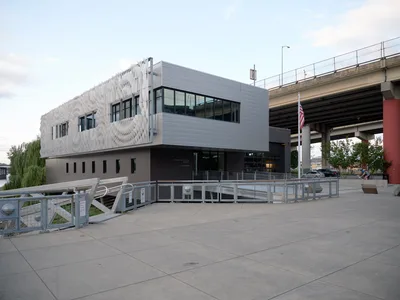
Portland Fire & Rescue Station 21 emerges as a striking example of contemporary public architecture beneath the Interstate 84 overpass in the Central Eastside district. The building's sculptural white facade features an undulating parametric pattern that contrasts dramatically with the corrugated metal upper level and industrial concrete surroundings. Captured during the golden hour transition, the structure's modern design philosophy transforms utilitarian emergency services architecture into an urban landmark that bridges infrastructure and community.
Portland Fire & Rescue Station 21 showcases innovative contemporary design with its sculptural white facade beneath Interstate 84 in the Central Eastside district.
Portland Fire Station 21 Contemporary Architecture
C
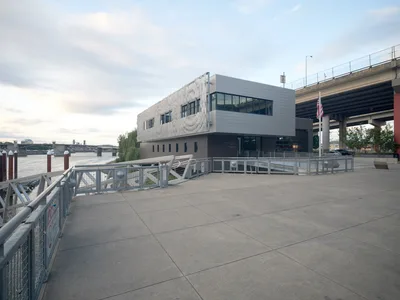
Portland Fire & Rescue Station 21 stands as a striking example of contemporary civic architecture along the Willamette River waterfront. The three-story building features a distinctive white sculptural facade contrasting with corrugated metal siding, positioned beneath the Southeast Madison Street bridge structure. Concrete walkways with metal railings frame the foreground under an overcast evening sky, while the distant river and bridge create layers of urban infrastructure.
Portland Fire & Rescue Station 21 showcases modern emergency services architecture along the Willamette River beneath the Southeast Madison Street bridge.
Portland Fire Station 21 Riverfront Architecture
C
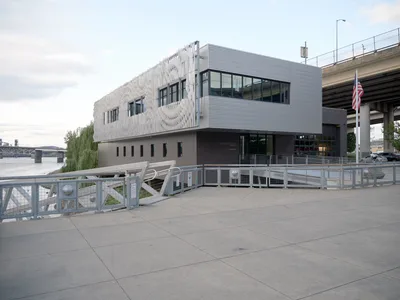
Portland Fire & Rescue Station 21 presents a striking contemporary facade beneath the evening's pewter sky, its sculptural white upper level contrasting sharply with the utilitarian concrete base. The building's distinctive undulating exterior panels create dramatic shadows while large glass windows reveal the operational spaces within. An American flag stands sentinel beside the waterfront structure, with the Willamette River and distant bridges completing this scene of municipal modernism.
Portland Fire & Rescue Station 21 showcases contemporary architectural design along the Willamette River in Portland's Central Eastside district.
Modern Fire Station Architecture Along Willamette River
C
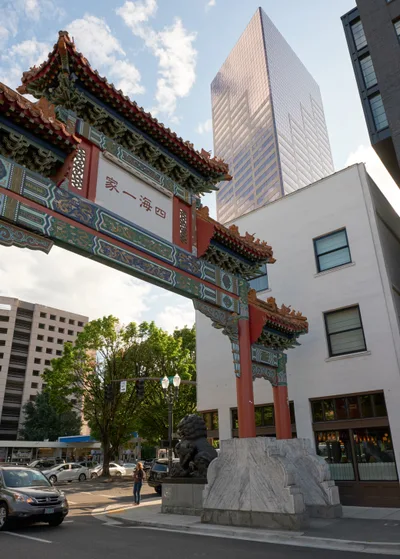
A striking architectural juxtaposition unfolds in Portland's Chinatown as an ornate Chinese ceremonial gate, adorned with vermillion lacquer and intricate dragon carvings, stands sentinel before gleaming glass towers. The traditional paifang, supported by granite guardian lions, creates a dramatic foreground against the contemporary urban backdrop of rose-tinted skyscrapers and residential buildings. Afternoon light casts gentle shadows across the busy street where pedestrians and vehicles navigate between centuries of architectural heritage.
A traditional Chinese paifang gateway frames modern high-rises in Portland's historic Chinatown district.
Traditional Gate Meets Modern Portland Skyline
B
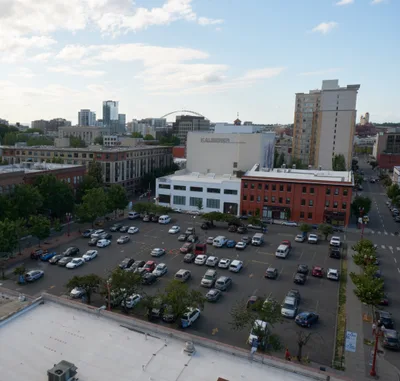
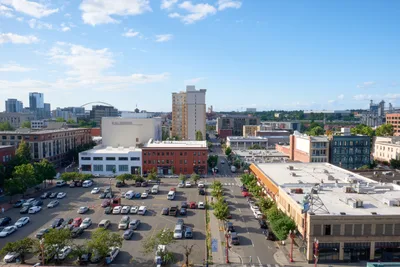
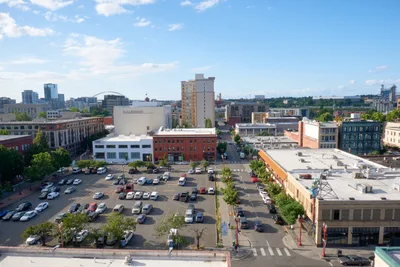
An elevated view captures the diverse architectural tapestry of Portland's Old Town district, where a surface parking lot serves as the immediate foreground beneath gathering afternoon clouds. The scene reveals the characteristic blend of historic red brick buildings and contemporary structures that define this Pacific Northwest neighborhood, with the Kalberer building prominently anchoring the middle ground. Soft natural light filters through a partly cloudy sky, casting gentle shadows across the urban landscape and creating depth between the foreground parking area and the distant high-rise towers.
Surface parking and mixed-use development characterize this aerial view of Portland's Old Town district beneath a partly cloudy afternoon sky.
Portland Urban Landscape Aerial Perspective
B
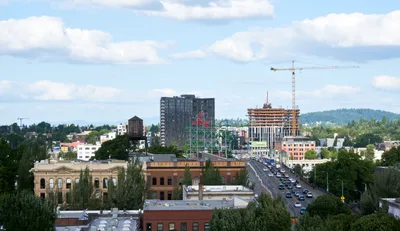
An elevated cityscape view captures Portland's Chinatown district where historic brick buildings meet contemporary high-rise construction. Tower cranes punctuate the skyline as new development rises alongside the ornate classical facade of a heritage building in the foreground. The Burnside Bridge carries steady traffic through the urban corridor, while forested hills provide a verdant backdrop to this evolving neighborhood where preservation and progress intersect.
Construction cranes tower over Portland's Chinatown as new high-rise development transforms the historic district beneath partly cloudy Pacific Northwest skies.
Portland Chinatown Development and Historic Architecture
B
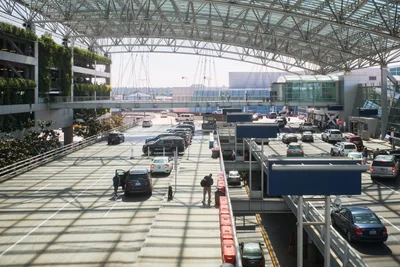
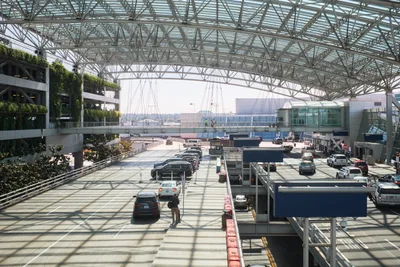
The multi-level departures roadway at Portland International Airport bustles with vehicular activity beneath a soaring canopy of steel trusses and glass. Cars queue in organized lanes while passengers load luggage and navigate the concrete plaza, creating a choreographed dance of arrival and departure. Dappled shadows from the architectural framework create geometric patterns across the pavement, while the terminal's modern glass facade gleams in the background. The scene captures the perpetual motion of modern air travel infrastructure, where engineering precision meets human transit needs.
Vehicles navigate the multi-tiered departures area at Portland International Airport under the terminal's distinctive steel and glass canopy.
Portland Airport Departures Traffic Flow
C
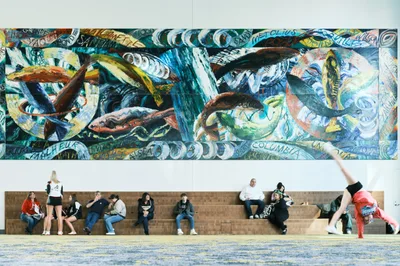
Visitors seek momentary refuge on stone benches beneath an explosive panorama of maritime-themed murals at Portland's Oregon Convention Center. The vibrant wall art, dominated by swirling blues and oceanic motifs interwoven with text fragments, creates a dramatic backdrop for the diverse group of attendees—from a breakdancer frozen mid-move to couples and individuals in casual repose. The juxtaposition of kinetic street art energy above and human stillness below captures the convention center's role as both cultural crossroads and temporary sanctuary.
Convention-goers rest beneath dynamic maritime murals in the Oregon Convention Center's foyer, where urban art meets public space in downtown Portland.
Urban Respite Beneath Explosive Maritime Murals
B
Beneath Portland International Airport's soaring latticed canopy, the departures driveway bustles with purposeful activity as travelers navigate the covered drop-off zone. The geometric steel framework creates dramatic shadows across the concrete surface while cars queue in organized lanes, their occupants preparing for journeys ahead. Green living walls on the terminal's left side soften the industrial architecture, while the distant mountains provide a serene backdrop to this choreographed transportation hub.
Travelers and vehicles move through the covered departures driveway at Portland International Airport beneath the terminal's distinctive steel canopy structure.
Departures Driveway Portland International Airport
C
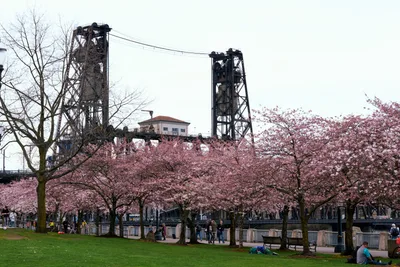
A canopy of pale pink cherry blossoms creates an ethereal foreground to Portland's iconic Steel Bridge, its weathered steel towers rising against an overcast sky. The delicate spring blooms along Tom McCall Waterfront Park form a striking contrast to the industrial architecture, while visitors stroll beneath the flowering trees on the emerald green lawn. The moody Pacific Northwest light softens both the blossoms and the bridge's geometric lines, capturing the quintessential juxtaposition of nature and industry that defines Portland's riverfront.
Cherry blossoms frame Portland's historic Steel Bridge at Tom McCall Waterfront Park along the Willamette River.
Spring Blossoms Frame Portland's Steel Bridge
B
An elevated afternoon view captures the bustling intersection of Northwest Portland's Pearl District, where historic brick buildings meet contemporary architecture under a canvas of scattered cumulus clouds. The scene reveals a well-organized street grid with tree-lined avenues, surface parking lots filled with vehicles, and the distinctive mix of red brick facades and modern glass structures that define this revitalized neighborhood. Golden hour light bathes the urban landscape, highlighting the textural contrast between the weathered industrial buildings and sleek residential towers rising in the distance.
The Pearl District's historic architecture and modern development converge in this aerial perspective of Northwest Portland's transformed warehouse district.
Pearl District Urban Vista from Above
B
An elevated view captures the bustling intersection of Portland's historic Chinatown district, where a sun-drenched parking lot anchors the urban composition. Mid-rise buildings in varied architectural styles create a textured skyline against wispy white clouds, while the Kalberer building stands prominently among mixed-use structures. The afternoon light bathes the scene in warm tones, revealing the neighborhood's blend of residential towers, commercial buildings, and tree-lined streets that define this evolving urban landscape.
An aerial perspective showcases the dynamic urban fabric of Portland's Chinatown district, where parking infrastructure meets diverse architectural styles under a bright Pacific Northwest sky.
Portland Chinatown Urban Vista from Above
B
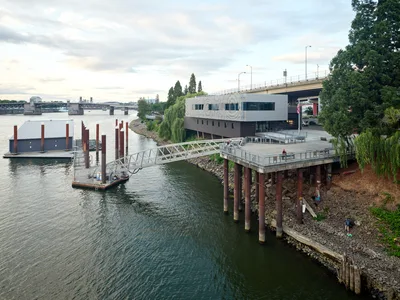
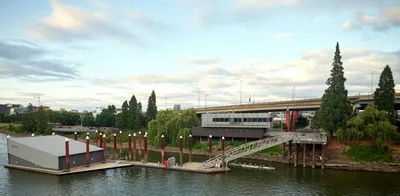
Portland Fire & Rescue Station 21 sits anchored in the Willamette River beneath the Southeast Madison Street Bridge, its modern floating structure serving the Central Eastside industrial district. The utilitarian gray building extends over dark waters on wooden pilings, connected to shore by a pedestrian gangway that spans the vegetated riverbank. Towering conifers and weeping willows frame the scene under a brooding Pacific Northwest sky, while the concrete bridge arches overhead, linking the city's urban fabric.
Portland Fire & Rescue Station 21 operates from its unique floating facility on the Willamette River at the foot of Southeast Madison Street.
Portland Fire Station 21 Floating Facility
C
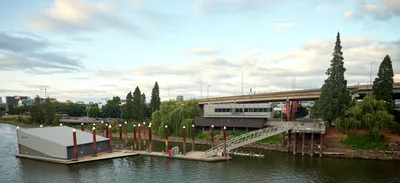
Portland Fire & Rescue Station 21 sits anchored on the Willamette River beneath the gentle light of an overcast evening sky. The modern floating firehouse, distinguished by its corrugated metal roof and red support pilings, connects to shore via a steel gangway, creating a unique waterfront emergency response facility. Towering Lombardy poplars frame the scene while the Hawthorne Bridge spans the background, establishing the station's strategic location in Portland's Central Eastside industrial district.
Portland Fire & Rescue Station 21 serves as a floating emergency response facility on the Willamette River in Oregon's largest city.
Floating Fire Station on Portland's Willamette River
C
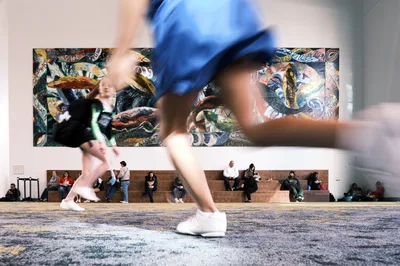
Blurred figures in motion streak across the foreground as visitors hurry through the spacious foyer of Portland's Oregon Convention Center. Behind them, spectators rest on terraced concrete steps beneath a vibrant, large-scale mural featuring serpentine forms and bold street art aesthetics. The juxtaposition of kinetic energy and static contemplation creates a dynamic urban tableau, with warm lighting illuminating the contemporary architectural space.
Visitors move through the foyer of Oregon Convention Center in Portland's Lloyd District, where a colorful mural provides backdrop for those taking respite on the stepped seating.
Motion and Murals at Oregon Convention Center
B
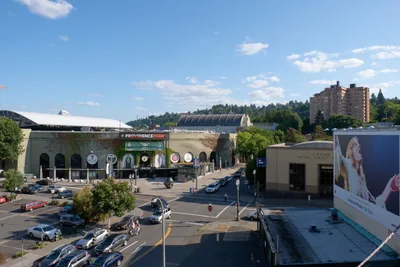
An elevated view captures the bustling urban landscape surrounding Providence Park stadium in Portland's Goose Hollow neighborhood. The distinctive curved architecture of the soccer venue dominates the center frame, while residential high-rises and forested hills create a layered backdrop under partly cloudy skies. Street-level activity unfolds below with parked vehicles and pedestrians navigating the intersection, while a large billboard advertisement anchors the right side of the composition.
Providence Park stadium sits nestled within Portland's urban fabric, where sports architecture meets residential towers against the city's signature tree-lined hills.
Providence Park Stadium Complex Portland Oregon
C
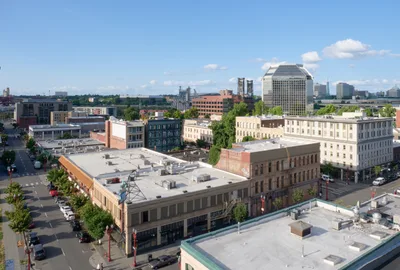
An elevated perspective captures Portland's Historic Chinatown district on a brilliant summer afternoon, where century-old brick buildings with ornate facades stand alongside modern glass towers. The warm golden light bathes the mixed-use streetscape, revealing the neighborhood's layered architectural evolution from historic commercial blocks to contemporary urban development. Tree-lined streets create geometric patterns between the vintage storefronts and newer residential buildings, while the distinctive domed tower of a prominent downtown building punctuates the distant skyline.
Historic brick buildings and modern towers create Portland's evolving Chinatown landscape under clear afternoon skies.
Portland Chinatown Historic District Aerial View
B
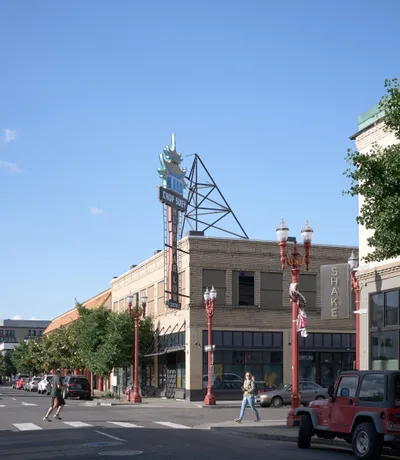
A pedestrian crosses the sun-drenched intersection in Portland's historic Chinatown district, where traditional pagoda-style signage crowns weathered brick buildings. The clear blue afternoon sky illuminates the distinctive red ornamental streetlamps and architectural details that define this cultural neighborhood. A red Jeep waits at the crosswalk as daily life unfolds along the tree-lined commercial strip, where vintage neon signs hint at the area's storied past.
Pedestrians navigate the historic intersection in Portland's Chinatown district, where traditional Asian architectural elements blend with Pacific Northwest urban landscape.
Portland Chinatown Historic District Crosswalk
B
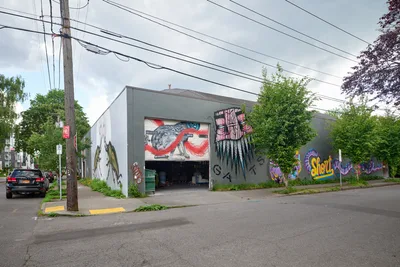
A weathered industrial warehouse in Portland's Kerns neighborhood serves as an expansive canvas for street art, its gray concrete facade adorned with vibrant murals including Native American-inspired imagery and contemporary graffiti tags. Power lines stretch across an overcast sky while mature trees frame the utilitarian structure, creating a quintessential Pacific Northwest urban landscape where industrial heritage meets artistic expression.
Street art transforms a concrete warehouse facade on Northeast Irving Street in Portland's Kerns district, blending industrial architecture with contemporary murals.
Urban Warehouse Canvas in Portland's Kerns District
B
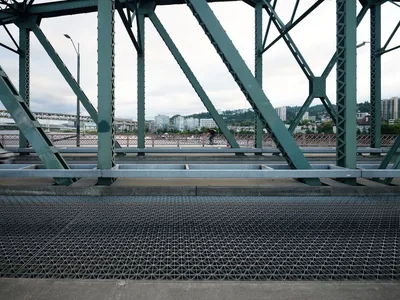
Industrial geometry frames the Portland skyline through the steel lattice work of the historic Hawthorne Bridge. Weathered green trusses create a rhythmic pattern of triangular supports, their riveted joints speaking to early 20th century engineering. Beyond the bridge's skeletal framework, modern residential towers rise against forested hills under an overcast Pacific Northwest sky, while the textured metal grating beneath adds tactile depth to this architectural intersection of past and present.
The iconic steel trusses of Portland's Hawthorne Bridge frame the city's evolving skyline across the Willamette River.
Steel Lattice Through Hawthorne Bridge Span
B

Search tags, trending this week